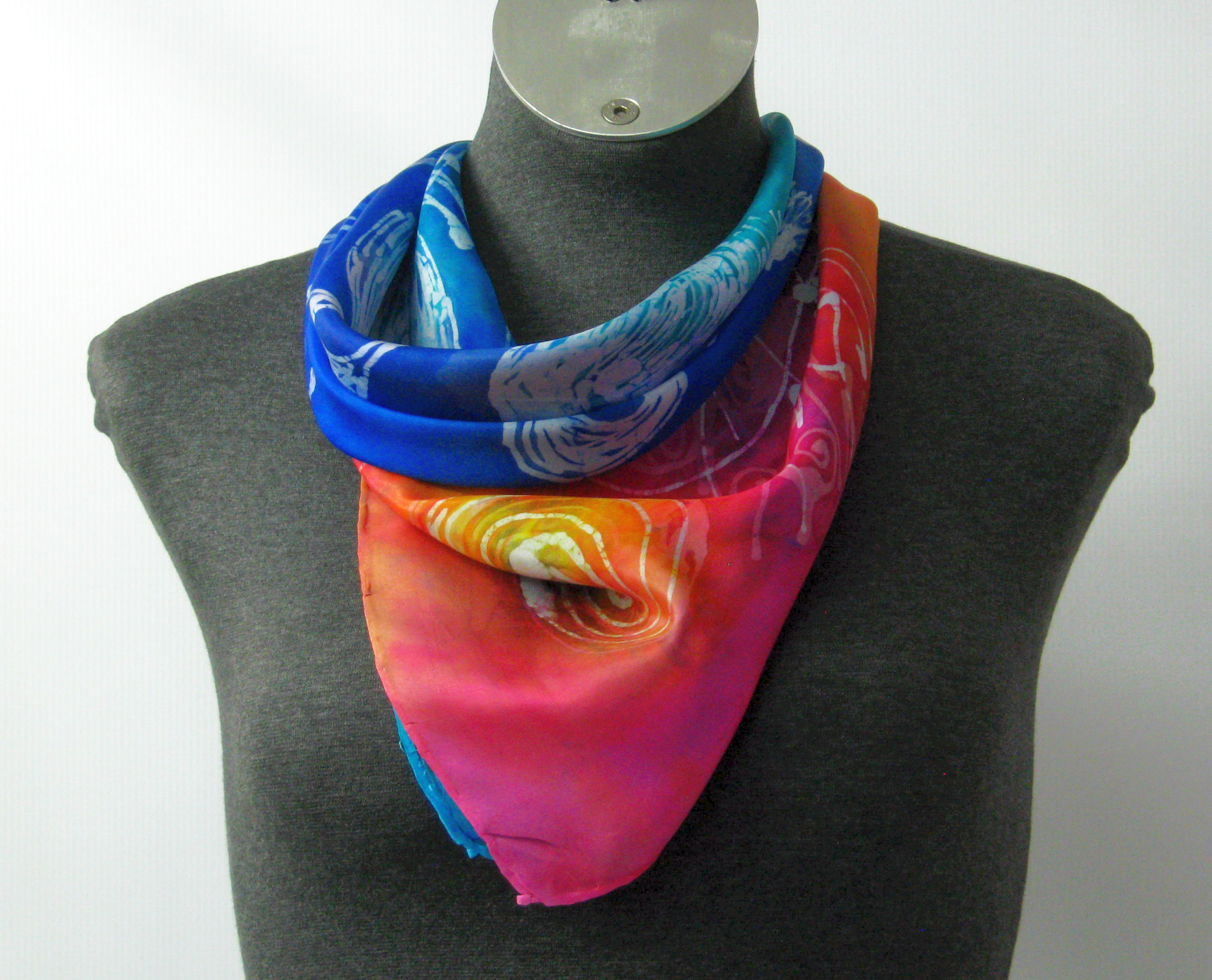
The Swan Bandana. Photo: Louise Loughman.
Louise Loughman‘s swan scarf began with a cool palette and a spiral moon. As she describes it, adding color to one corner changed the scene.
“I felt it needed a pop of colour so I added a blend of orange and yellow at the top corner, so what was once intended to be a cool spiral moon became a warm sunrise,” Loughman said.
The scarf draws on The Children of Lir, which she describes as a Celtic story of four children transformed into swans by their stepmother. Her account of making it follows a design that gains definition in wax while still leaving decisions for the dye.
Her preparation starts with sketches and a decision about the design. “I do a larger sketch that can be used as a pattern to trace directly onto the scarf using hot wax,” Loughman said.
While drawing on the scarf, she says she may add lines and embellishments that create movement and incorporate accidental drips or splashes. “I like to get artistic and turn them into flowers, butterflies, or spirals,” she said.
Once the wax drawing is complete, she describes color as a place to experiment because the image is already established. That is where the intended blues and greens made room for the orange and yellow sunrise.
The same image has another set of possibilities when it leaves the work surface. On the small square scarf, Loughman says she places the design diagonally so part of the swan remains visible around the neck.
She describes contrasting corners, one showing blue and green and the opposite showing pinks and yellows, that give the wearer different choices when pairing the scarf with clothing. The color decision continues through how the scarf is worn.
On longer scarves or shawls, she says she usually puts four swans at one end and a Celtic wave pattern at the other. “When the wearer puts the scarf on and the two ends sit side by side, it tells a little bit more of the story,” Loughman said.
That relationship between an image and what the material allows also shapes her custom work. She says detailed drawings or words can be difficult in wax, so she looks for a simpler image or an alternative word.
“I personally think colour can make or break a scarf and silk takes colour so well it can be both subtle and vibrant with equal success,” she said.
In the swan scarf she describes, the wax holds the drawing together while color changes a moon into a sunrise, and the wearer decides which corner comes forward.