By Debbie Johanson
In Never Say Never, a playground encounter becomes a face, a door knocker and a record of the years between them.
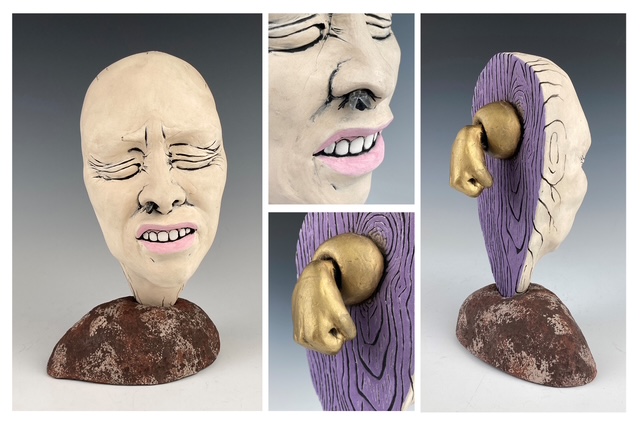
A fist-shaped door knocker sits on the back of the head in Emily Rensink’s Never Say Never. The sculpture gives a childhood incident a physical place to linger: a face remembers the event, and the knocker carries the ritual that followed.
“They are usually those that had a strong emotional impact, one that stuck with me though time,” Rensink wrote in an email interview about the experiences that become her Memory sculptures.
Some of those memories gather across encounters. She described Life Over Coffee as holding the joy of talking with friends and family over coffee; Never Say Never begins with one much less welcome interruption.
In elementary school, classmates were discussing whether a bug had ever flown up their noses. Rensink said it had never happened to her.
“Much to my chagrin, while walking back to class, one promptly took a nose dive into my right nostril, likely wondering who had turned off the lights while I sputtered and flailed in efforts to dislodge it,” she wrote.
Her account supplies the sculpture with both an event and an aftermath. Knocking on something to ward off an unwanted possibility is the habit she traces back to that playground conversation.
“The sculpture comprises a rock-like base, representing the solidity and foundation of the experience, with the face portion of a head balanced atop,” Rensink wrote.
“The face tells the story of the original event, and the wood grain back with the fist door knocker represent the resulting superstition that has followed me throughout my life,” she explained.
The base makes the memory substantial, while color gives the ritual its own value. Rensink connects the browns to the rock’s weight and the purple and gold to the importance she has given the habit.
“The wood grain of the back of the head wraps around to the face and turns into cracks, this along with the contrast of the older face and the cherubic hand speak to a span of time,” she wrote.
That span is part of the object’s story. The remembered child, the older face and the repeated knock share a sculpture, bringing the original experience into contact with the years it has accompanied.
Rensink hopes the work can prompt viewers’ own reflection, with room for a response she has not prescribed. Living with a piece also gives that response time to change.
“Over time I hope they notice something new about the work that they might not have seen before, be it about the piece itself, the story it tells, or by how the narrative changes when it is put in conversation with other artworks or locations,” she wrote.