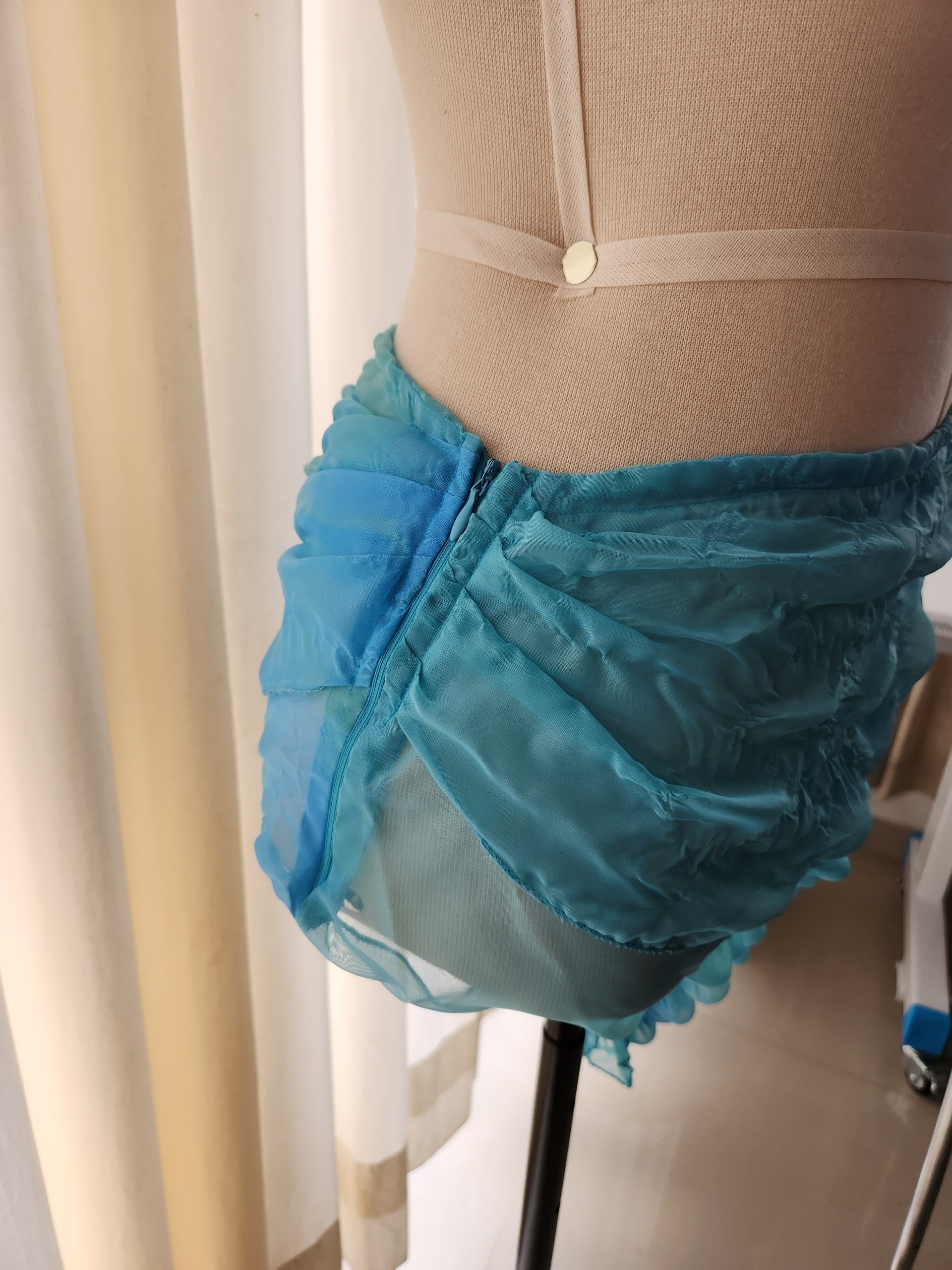
The aqua-green skirt began with an interest in forms that seem almost magical: coral, algae and marine animals. For KINDKUKI, bringing those shapes into clothing meant finding objects that could temporarily hold the fabric in a new form.
“The intention of the shibori relief in our second collection was to add a playful aspect to the final looks,” Aninha wrote in Portuguese responses for this feature. Quotations here are translated from those written answers.
She first experimented with ways to color the polyester voile, eventually using digital sublimation to get the shade she wanted. After shaping the piece on a draping mannequin, she worked the fabric around marbles and stones found in the street.
“I believe the main part of this process is choosing the objects that shape the fabric through the ties that are made,” she wrote.
That choice made the process open to experiments with things already at home. Because this three-dimensional shibori involved boiling the tied fabric, the objects also needed to withstand the heat.
“So I gathered some things I had at home, such as walnuts, stones, gravel and even a lemon!” she wrote.
Some experiments introduced an unplanned color. Materials released pigment when heated and stained the fabric; she now prefers marbles, coins or hairpins.
“Some of these tests didn’t work very well, to be honest!” she wrote.
The results also changed how the skirt needed to be cut. The raised forms took up fabric, making a pattern drawn for the intended finished size too small.
“The shapes and reliefs of shibori cause a ‘shrinking’ effect in the fabric, so we learned to draw patterns at twice the desired size for the final piece,” she wrote.
Prototype garments helped establish that change. They also showed what the relief would do once someone wore the finished piece.
“In movement, the fabric with shibori behaves well, considering that the relief gives the fabric a new type of elasticity, even without elastane in its composition,” she wrote.
The objects eventually come out, but the choices they made possible remain in the silhouette and in the way the cloth moves. A marble or a hairpin becomes part of a garment’s shape without having to stay inside it.