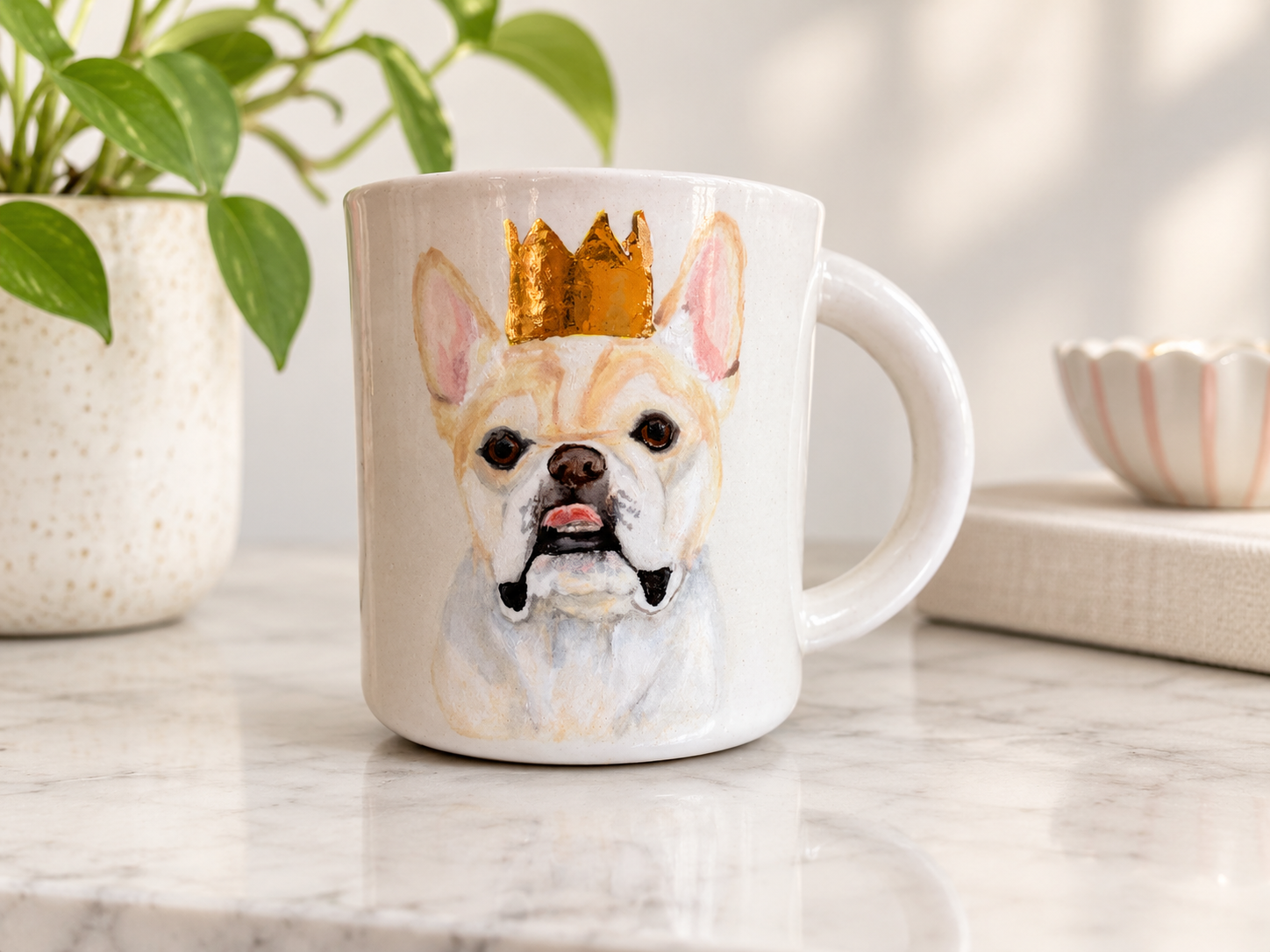
A pet portrait has to survive a change of surface at Hadley Clay. The animal arrives in photographs, but Hadley Sedgwick paints the likeness around a mug, where the curve changes what someone sees as they turn it in their hands.
“Every piece starts with photographs supplied by the pet’s owner,” Sedgwick said in an email interview. “I study their markings, coloring, facial features, and little expressions to get a sense of what makes that particular animal recognizable.”
The idea joins two interests she has had for a long time: animals and making things by hand. She wanted the portrait to have a place in an ordinary routine.
“Rather than a portrait that hangs on a wall, I love that someone can start their morning drinking coffee from a mug featuring their best friend,” she said.
Making that meeting between a familiar animal and a useful object takes several stages. “I slab build the clay to form a mug in porcelain, and once it’s bisque fired, I handpaint the portrait using ceramic underglazes,” Sedgwick said.
The mug’s curve makes the painting a problem of angles as well as likeness. “It’s a fairly meticulous process, especially because I’m working on a curved surface and need to consider how the portrait will look from different angles,” she said.
The eyes receive particular attention. “I think they capture so much of an animal’s personality, and even the smallest details can make the difference between a painting of a dog or cat and a painting that actually looks like their dog or cat,” Sedgwick said.
After the painting, she glazes the piece and fires it again. In her account, that firing changes the colors and brings the finished surface into place.
The owner’s part of the process begins before the clay. “I love having several clear, well lit photos, ideally taken in natural light, so I can really see the pet’s coloring, markings, and features,” Sedgwick said.
A distinctive expression can be as useful as a clear view of a marking. “Sometimes it’s the slightly crooked ears, a funny expression, a particular way they sit, or a distinctive marking that makes a portrait feel uniquely theirs,” she said.
She also welcomes a pet’s name, its habits and a little about its personality. “Those little details help me understand who I’m painting, rather than simply what they look like,” Sedgwick said.
That is what the owner can contribute alongside a good photograph: the detail that makes this animal recognizable to the person who lives with it. Sedgwick’s job is to carry it around the curve of a mug and into the next morning’s coffee.