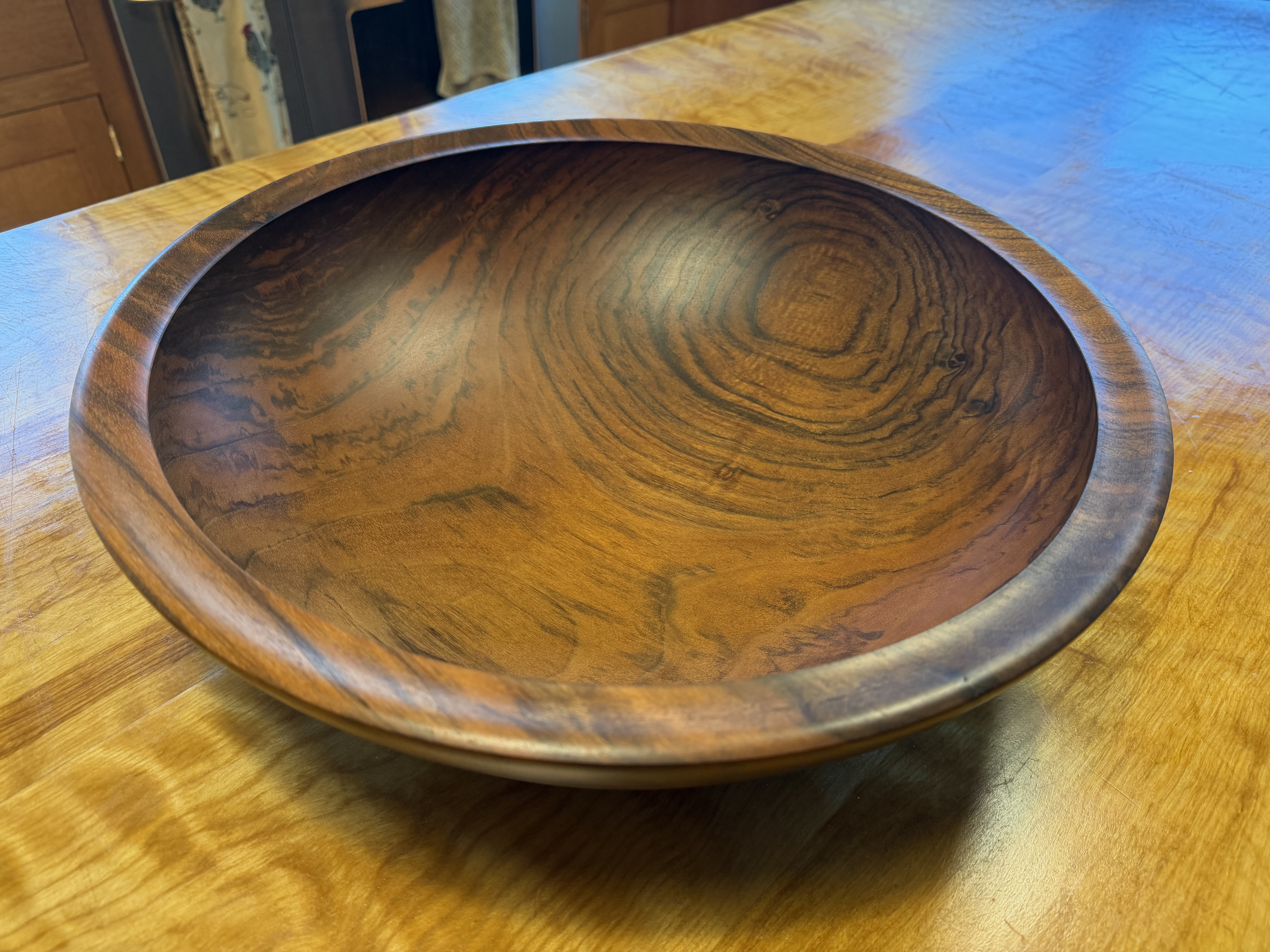
The wood in one of Mike Mahoney’s bowls came from an 85-year-old walnut orchard tree in the Sacramento Valley. He traced it to the upper part of the tree, above the graft line- a specific starting point for an object he wants someone to keep using.
“In order to make a bowl that you want to last and be used there is a lot to consider,” Mahoney said in an email interview. The choice begins with the species of tree.
He named maples, walnuts, fruit woods, oaks and ash as examples of the woods he favors for that purpose. “These woods tend to absorb shock and wear better than very dense hardwoods like Hickory, Locust, rosewoods and many more,” he said.
The orchard tree gave him what is commonly called English walnut. Its particular history sits inside a larger practical question: how will this material behave once the bowl leaves the workshop?
That question carries into the finish, where Mahoney’s preferred answer is unusually spare. “I would say the best finish is to not have a finish at all,” he said.
He immediately qualified the idea. “There is a fault in this way of thinking because it is hard to sell without it,” Mahoney said.
His next choice is a penetrating oil, with mineral, walnut and soybean oils among the examples he gave. “These oils go into the wood and give depth to the grain,” he said.
Their usefulness continues after the maker has applied them. “The best part about these oils is anyone could apply them,” Mahoney said. “No skill required, unlike film finishes.”
A finish the owner can apply keeps some of the care within that person’s reach. But when Mahoney teaches someone to make a bowl, he starts before the surface treatment, with the risks of the machine doing the shaping.
“First thing on a lathe made bowl is safety,” he said. “It can be a very dangerous craft.”
After safety, Mahoney turns to the grain: how to cut and dry it to avoid cracks. The lesson keeps the wood’s behavior in view long before a finished bowl is put to use.